
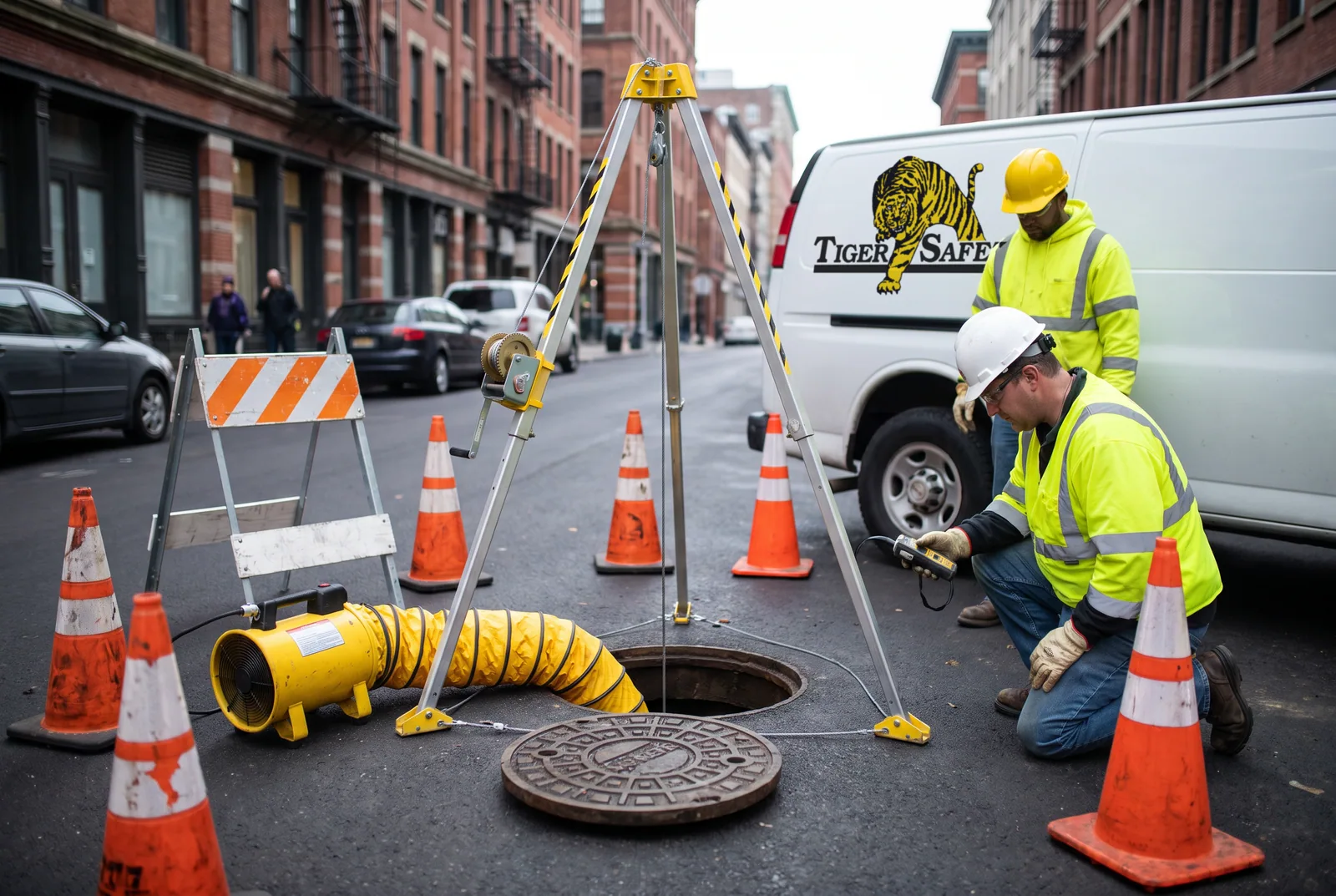
Yes, a manhole is a confined space. It is big enough to climb into, it has a limited way in and out, and it was never built for anyone to stay in, which are OSHA’s three tests. Most sewer manholes are also permit-required confined spaces, because the air inside can turn dangerous: too little oxygen, methane, or hydrogen sulfide.
That answer also sets your equipment list: a gas monitor, a blower, a way to pull someone out without climbing in, and a trained attendant at the opening.
Is every manhole a permit-required confined space?
Not every one, but most sewer manholes are. A confined space becomes a permit space when it has any one of these:
- a hazardous atmosphere, or the potential for one
- material that could engulf someone
- walls that taper inward and could trap a person
- any other serious hazard
A sanitary sewer manhole meets the first one almost by default. A dry telecom manhole on a quiet street might meet none of them and count as a non-permit space.
Even then, gas travels into underground structures through conduit and soil. Classify the manhole by what you find the day you open it, not by what the drawing says.
Does running a blower make it a non-permit space?
No. OSHA is plain about it: controlling bad air with a blower does not eliminate the hazard. A sewer manhole that is only safe while the blower runs is still a permit space.
What a blower can earn you is a lighter procedure. If the air is the only hazard and monitoring data shows that continuous ventilation alone keeps the space safe, the formal permit, attendant and rescue requirements drop away. The crew still guards the opening, tests before entry, ventilates until everyone is out, retests, leaves if a reading turns, and keeps a signed certification. The first entries that collect that data run under full permit rules.
Full reclassification to non-permit is stricter: every hazard gone, the air included, with a signed, dated certification.
Which OSHA rule covers your crew?
It depends on the work, not the hole.
| The work | The rule that applies |
|---|---|
| Sewer, storm and water maintenance and inspection | OSHA’s general industry confined space rule, with the full permit program |
| New installs, rehab and tie-ins | OSHA’s construction confined space rule |
| Telecom work on underground lines | OSHA’s telecommunications rule, which has its own section for manholes and unvented vaults |
| Electric utility manholes and vaults | OSHA’s electric power rule, which calls them “enclosed spaces” and has its own entry procedure |
The general industry rule says outright that it does not apply to construction. On a construction job, a competent person has to identify every confined space and permit space on the site before work starts.
The telecom and electric rules have limits. A telecom manhole with a hazard its section doesn’t cover, or an electric vault with hazards that could endanger life or block escape, goes back to the full permit rules. With energized equipment in a manhole or vault, someone trained in first aid also stays on the surface near the entrance.
Test the air in order: oxygen, flammables, toxics
Oxygen comes first because a combustible gas sensor needs oxygen to read right. In a low-oxygen space, the LEL reading can look safer than it is.
Sample at several depths, not just at the rim. Methane is lighter than air and collects high. Hydrogen sulfide is heavier and settles in the invert and the sump.
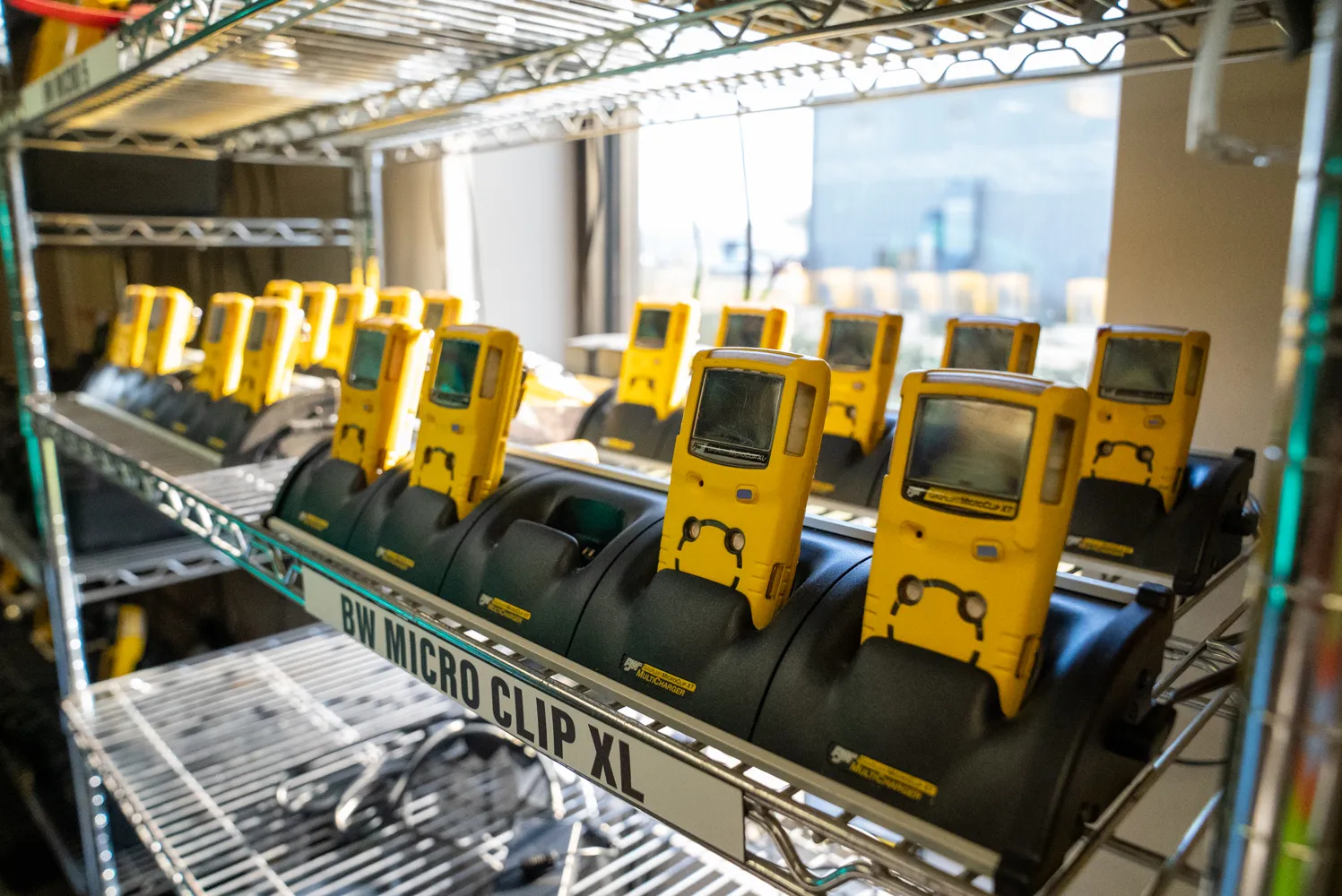
A sewer manhole on a connected line can’t be isolated, so gas can move in from upstream at any time. For a line like that, the rule calls for continuous monitoring where people are working. Clip a four-gas personal monitor (oxygen, LEL, CO and H2S) on each entrant and set an area monitor with a wireless alarm at the opening, so the attendant hears what the entrant hears.
How dangerous is H2S in a sewer manhole?
Bacteria breaking down sewage in low oxygen give off hydrogen sulfide. It collects in wet wells, lift stations, force main discharges and low spots where flow slows. It can sit quietly for hours, then come out in a burst when a pump kicks on or someone stirs the sludge.
The numbers, covered in full in our H2S exposure limits guide:
- OSHA’s general industry ceiling is 20 ppm, with a 50 ppm peak allowed for up to 10 minutes once per shift if no other measurable exposure occurs.
- NIOSH recommends a 10 ppm ceiling.
- 100 ppm is immediately dangerous to life and health (IDLH).
Around 100 to 150 ppm, H2S knocks out your sense of smell. The rotten egg odor fades right as the gas turns dangerous, so nobody down there should trust their nose. Put a continuous monitor on every entrant. If readings could approach the IDLH, entrants need SCBA or supplied air, not a cartridge respirator.
Where to set the manhole blower
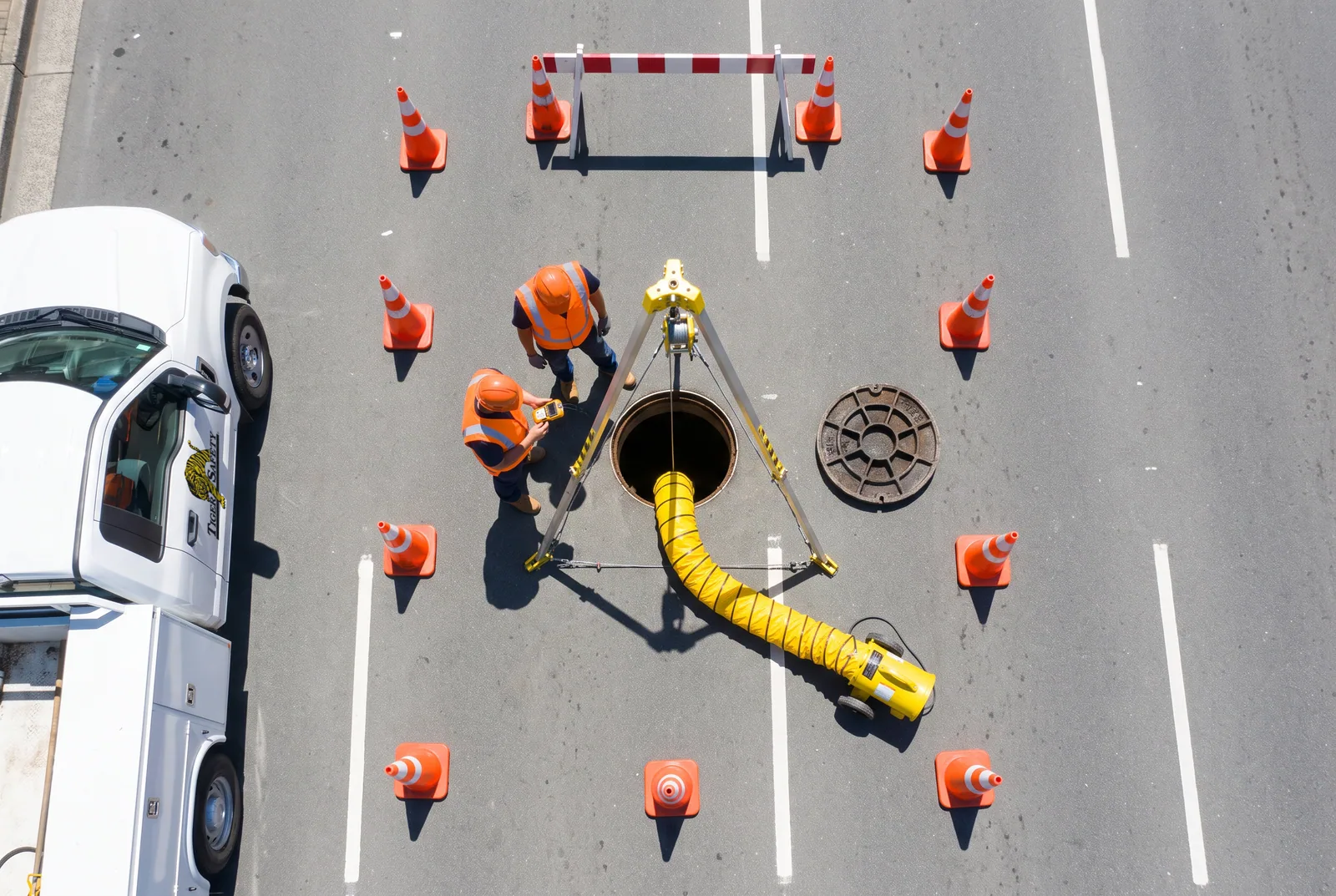
A blower only helps if clean air reaches the people inside. On the street:
- Set the intake upwind of trucks, generators and saws. An idling engine near the intake pushes carbon monoxide down the hole.
- Keep the intake away from the opening, where the bad air comes out.
- Run the duct down to the work area, or fresh air short-circuits out the next opening in the line.
- Purge, retest, then enter. Keep the blower running until the last person is out.
- Use explosion-proof equipment wherever methane is possible, which in a sewer is nearly everywhere.
Tiger rents explosion-proof blowers, electric and pneumatic, plus larger jet fans for wet wells. Blower rentals come with a manhole saddle or duct support that holds the duct in the opening without blocking the entry path. See the ventilation rental lineup.
Who has to be standing at the opening?
Confined space fatality reports keep describing the same sequence. A worker drops at the bottom of a manhole, a coworker climbs down to help, and the same air takes them both.
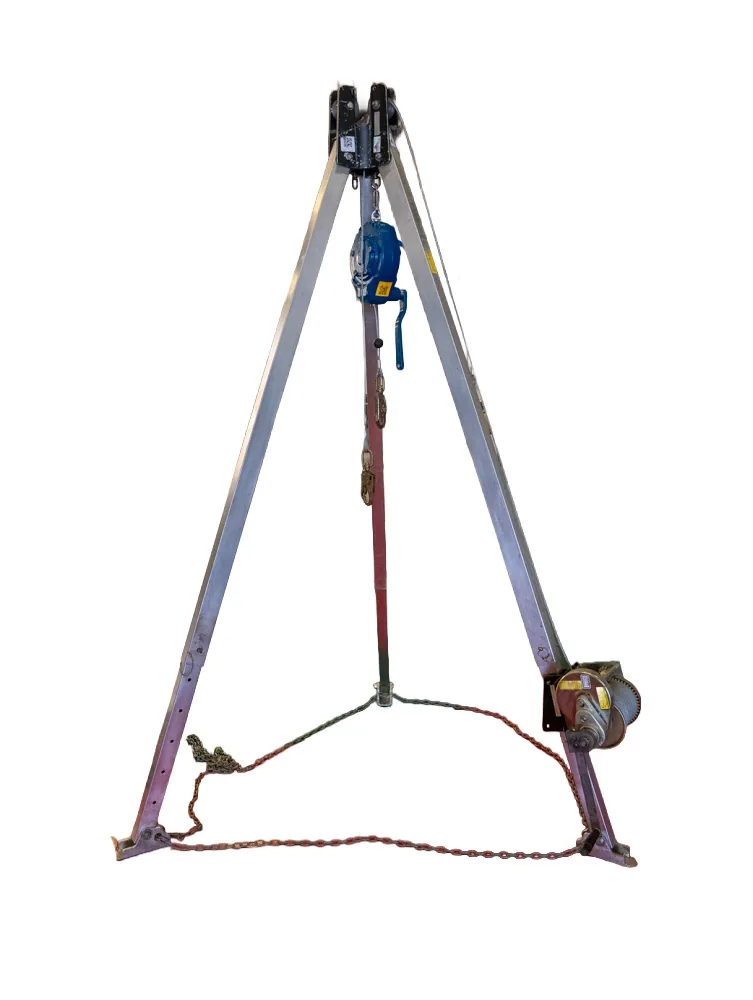
So plan a rescue where nobody climbs in. Each entrant wears a harness tied to a retrieval line anchored outside, and any vertical permit space deeper than 5 feet needs a mechanical device on hand. On a manhole, that’s a man-rated winch on a tripod or davit, rigged before the first person goes down.
The attendant, or hole watch, stays at the opening, watches the monitor and runs the winch. They bring an entrant up from the surface and do not go in after them. Where a winch can’t do it, like a horizontal run where the line would snag, rescue falls to a trained team on breathing air, and that plan goes in the permit before the cover comes off.
What you need on site for a manhole entry
- A calibrated four-gas monitor on each entrant, plus an area monitor at the opening
- An explosion-proof blower with duct long enough to reach the work
- A tripod or davit with a man-rated winch, rigged before entry
- A harness and retrieval line for each entrant
- A guard or barricade around the opening
- SCBA or supplied air if H2S or low oxygen could get dangerous
- A trained attendant at the opening for the whole entry
- The permit with the rescue plan written in, or the alternate-procedure certification
Frequently asked questions
Is a manhole a permit-required confined space?
Every manhole is a confined space, and most sewer manholes are permit-required because they can hold a hazardous atmosphere. One with no actual or potential hazards can be non-permit, but only after an evaluation says so.
Does 1910.146 apply to manhole work in construction?
No. 1910.146 states that it does not apply to construction. New installs, rehab and tie-ins fall under 1926 Subpart AA, where 1926.1203(a) requires a competent person to identify every confined space and permit space on the site before work begins.
Do you need a confined space entry permit to enter a manhole?
Yes for a permit-required manhole, unless the alternate procedures in 1910.146(c)(5) apply: the only hazard is atmospheric and continuous forced air ventilation alone keeps the space safe, backed by data and a written certification. Telecom and electric utility crews follow 1910.268(o) and 1910.269(e) and (t) for routine manhole work.
Does ventilating a manhole make it a non-permit confined space?
No. OSHA’s note to 1910.146(c)(7) states that controlling atmospheric hazards with forced air ventilation does not eliminate them. A ventilated manhole may qualify for alternate procedures, but it cannot be reclassified as non-permit because a blower is running.
What does OSHA 1910.268 require for a telecommunications manhole?
Guard the opening, test for combustible gas (and oxygen deficiency unless forced ventilation is running) before entry, ventilate if conditions are unsafe, and keep a continuous air supply in set cases, such as after combustible gas was found or when the manhole is in a traffic lane.
Opening a manhole or vault this week?
Tiger Safety Rentals supplies the entry package for utility work: four-gas monitors and wireless area alarms, explosion-proof blowers and ducting, tripods, davits and man-rated winches, rescue gear such as rescue stretchers and lifelines, and SCBA or supplied air for the entries that need it. We can also staff the entry with trained confined space attendants or a standby rescue team. Call 888-365-5220 for 24/7 dispatch.
Sources
- OSHA 29 CFR 1910.146: permit-required confined spaces in general industry, including when a space needs a permit, the alternate procedure for ventilated spaces, reclassification, air testing in sewers and other connected systems, and retrieval systems.
- OSHA 29 CFR 1926 Subpart AA (1926.1203): confined spaces in construction, including the competent person’s site evaluation and multi-contractor coordination.
- OSHA 29 CFR 1910.268(o): guarding, testing and ventilating telecommunications manholes and unvented vaults.
- OSHA 29 CFR 1910.269(e) and (t): entry into enclosed spaces, manholes and vaults in electric power work, including the first aid attendant near energized equipment.
- OSHA and NIOSH hydrogen sulfide limits: the exposure ceilings and IDLH, summarized in our H2S exposure limits guide.
